Showing posts with label Transmission. Show all posts

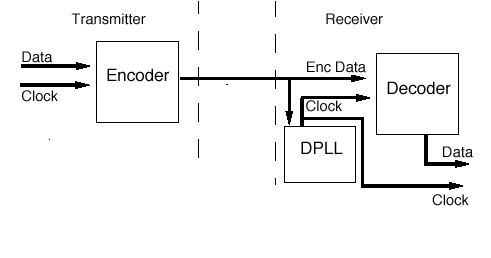
Synchronous Transmission:- Synchronous transmission is a method of data communication that requires the source and destination to synchronize their clocks together. This synchronization of the clocks can occur externally to the data information or be incorporated with the data information. There are two types of synchronous data transmission (or communication):

* Externally clocked synchronous transmission
* Internally encoded synchronous transmission

The advantage to having the clocks synchronized is that longer blocks of data can be sent without loss of synchronization. Less overhead is required for the amount of data sent. In asynchronous transmission, there are 3 to 4 bits of overhead (start, stop, parity bits) sent with each character of data (7 to 8 bits). The start and stop bits were used to identify the beginning and end of transmission.

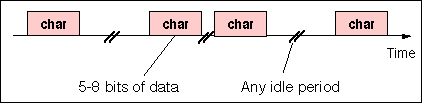
Asynchronous Transmission:-The asynchronous communication technique is a physical layer transmission technique which is most widely used for personal computers providing connectivity to printers, modems, fax machines, etc. The most significant aspect of asynchronous communications is that the transmitter and receiver clock are independent and are not synchronised.

In fact, there need be no timing relationship between successive characters (or bytes of data). Individual characters may be separated by any arbitrary idle period.

--------------------------------------------------------
Human do error, please email:- webmaster@piyadas-world.com if you find any. Please visit http://www.piyadas-world.com for more resource.
Read more...

Here is a small but helpful discussion about analog and digital transmission.

i. Analog Transmission:- In an analog transmission system, signals propagate through the medium as continuously varying electromagnetic waves. In a digital system, signals propagate as discrete voltage pulses (that is, a positive voltage represents binary 1, and a negative voltage represents binary 0), which are measured in bits per second. The medium for an analog transmission may be twisted-pair cable, coaxial cable, optical-fiber cable, the atmosphere, water, or space. A technique called "modulation" is used to combine an input signal (the data) onto a carrier signal. The carrier signal is a specific frequency. When tuning a radio, you select a particular carrier frequency in order to tune in that radio station. There are two primary modulation techniques: amplitude modulation, which varies the amplitude (height) of the carrier signal; frequency modulation, which modulates the frequency of the carrier.A modem converts digital data to analog signals. Alternatively, analog signals can be converted to digital information using a codec (coder/decoder). This process is called digitizing.


ii. Digital Transmission:-Digital signal is a discontinuous signal that changes from one state to another in discrete steps. A popular form of digital modulation is binary, or two level, digital modulation. In binary modulation the optical signal is switched from a low-power level (usually off) to a high-power level. There are a number of modulation techniques used in digital systems, but these will not be discussed here. For more information on digital modulation techniques, refer to the References listed in appendix 2. Line coding is the process of arranging symbols that represent binary data in a particular pattern for transmission. The most common types of line coding used in fiber optic communications include non-return-to-zero (NRZ), return-to-zero (RZ), and biphase, or Manchester.


--------------------------------------------------------
Human do error, please email:- webmaster@piyadas-world.com if you find any. Please visit http://www.piyadas-world.com for more resource.


Read more...